


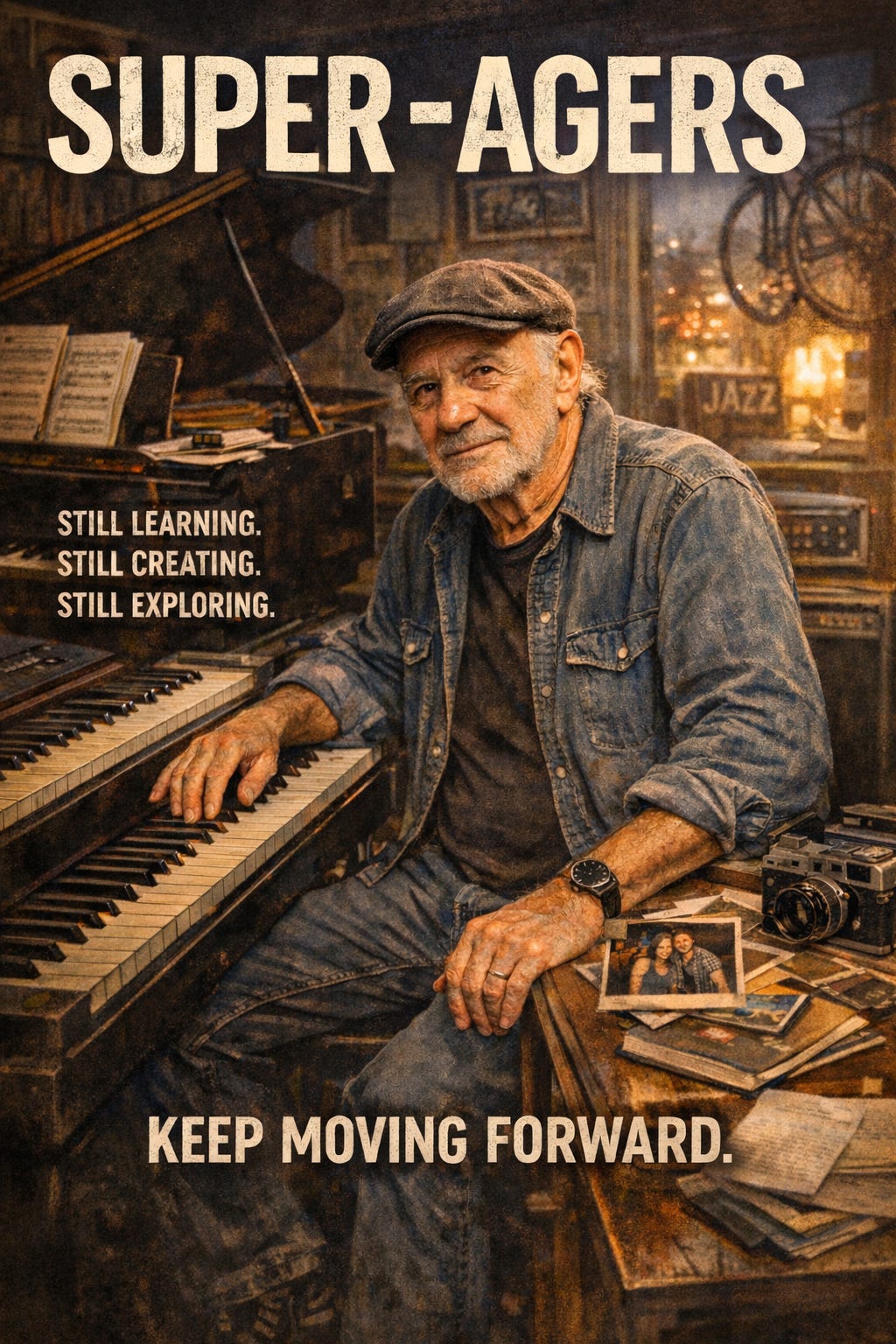
Mondays have started to take on a different weight for me.
Saturday belongs to I Love a Piano. That column demands time and preparation. A full week of listening, researching, chasing down stories, and rounding up the great players of the 88 keys like old friends gathering in a room. By the time it’s written, I’ve lived with it.
Sunday tends to be quieter. Reflective. The day when the larger world creeps in — the steady rise of violence, the constant churn of misinformation, the noise that never seems to shut off. It’s hard not to sit with all of that and wonder where we’re heading.
Then something small will cut through.
My friend, musician Duncan Fremlin, has been posting clips about research from Western University on “super aging.” Studies about people in their eighties and nineties whose minds are still sharp, still engaged, still curious. Not surviving — participating.
I pay attention to that now.
Because most mornings I find myself sitting behind multiple keyboards, months away from eighty, still practicing, still learning songs, still chasing improvement like a kid. Not with nostalgia. Not counting losses. I’ve had a full life. Rich in experience, sharp turns, mistakes, victories. But I remember clearly where my resistance to the idea of aging began.
Seventh grade. An associate principal filling in for a teacher decided to give us a preview of our futures. Very matter-of-fact. You stop growing at twenty. Your mind declines after thirty. By fifty, you’re winding down, headed for retirement, basically on the way out. Even then, it made me angry. Who was this guy to lay out the limits of my life like a train schedule?
I went home and calculated the date of my fiftieth birthday. I promised myself I’d meet it head-on, living freely out of pure defiance. When fifty arrived, nothing collapsed. I still played basketball. Still listened to music for hours. Photographed the streets. Rode my bike everywhere. Put in a few thousand kilometres a year without thinking twice. Hung out with family and friends. Life looked exactly like it always had.
Kristine and I kept our summer ritual — biking across the city to the Beaches International Jazz Festival, exhausting ourselves with music and crowds, then riding home along the lake in the dark. Long, taxing rides, but we were fit and happy. Then, at fifty-nine, I had a low-level heart attack. Five stents later, I was back on the bike.
A scare like that force’s reflection. You start thinking about the road ahead. How long is it? What obstacles might still be waiting? But even then, the core didn’t change.
I never wanted a day job. I built my life around avoiding one. I pieced together income through the arts and accepted the sacrifices that came with that freedom. I parked my car in 1979. Let the license expire in 1980. Never bought another. Suddenly, there was money to live on. In 1995, I quit cigarettes and weed. More money. More breath. More clarity.
Every decision was simple and practical, but each one nudged me toward a better future. When someone suggested the mind inevitably declines with age, it irritated me. There was too much left to learn.
At one point, I realized I couldn’t afford film, processing, and printing if I kept smoking. So, I quit. That choice quietly bloomed into a second career in photography. Then writing took hold. What started as a fantasy became an obsession. Words lined up on paper, painting entire rooms inside my head — travel, terror, love, memory. Nothing else competed with that feeling. So, I went to night school.
Not the anxious classrooms of youth, not grades and pressure. It became a refuge. I read my stories aloud. Let classmates and instructors take them apart. I felt fearless and fearful at the same time. So much to say. So little protected inside.
But I kept showing up.
We all have.
We’ve lost too many friends, relatives, people we assumed would be here longer. The simple fact that we’re still around makes us the fortunate ones. You live the day that arrives. You don’t cling to life because it owes you something. You step forward because you’re curious what happens next. That’s what the researchers call “super agers,” but it doesn’t feel heroic. It feels practical.
Most SuperAgers are outgoing. Cheerful enough. Not big complainers. We just can’t resist life. The next encounter. The next conversation. The next stretch of sunlight along the river.
A few days ago, I was riding the streetcar home from the Redwood Theatre after meeting with Les Stroud — the guy who created Survivorman. Seven days alone in frozen forests with almost nothing. That kind of grit. It was twenty below. He was bundled up and tired, yet surviving.
A young man of East Indian descent sat across from me and studied me for a minute before leaning over.
“Sir, you look very interesting. What do you do?” I laughed. I told him about the theatre, the work, and why I still do it. “You still work? Not retired?” he asked.
Nope.
Turns out he’s a professional chef. Israeli cuisine. Wants to build a TikTok and YouTube channel to grow his brand. He talked about seasoning, preparation, and catering gigs — full of energy and plans. And just like that, age disappeared. He needed what I knew — editing tools, plug-ins, tutorials, and how to shape a story.
I needed what he had — that forward momentum, that spark. So we traded. Advice for enthusiasm. Experience for the spirit. Two strangers on a cold streetcar are helping each other move ahead. That, to me, is who we are now.
We’re walking libraries. We took the hits, patched ourselves up, and kept going. The stride may stiffen. The heart may need repairs. But curiosity, decency, creativity — those don’t fade unless we let them. They stay with us right until the last chapter closes.
Maybe that’s what a Monday column should hold.
Not decline.
Not fear.
Just evidence.
Proof that we’re still here — still learning, still meeting strangers, still pedalling home in the dark, still saying yes to whatever the day places in front of us.
Cheers.
I’m on it
Biking is beautiful