


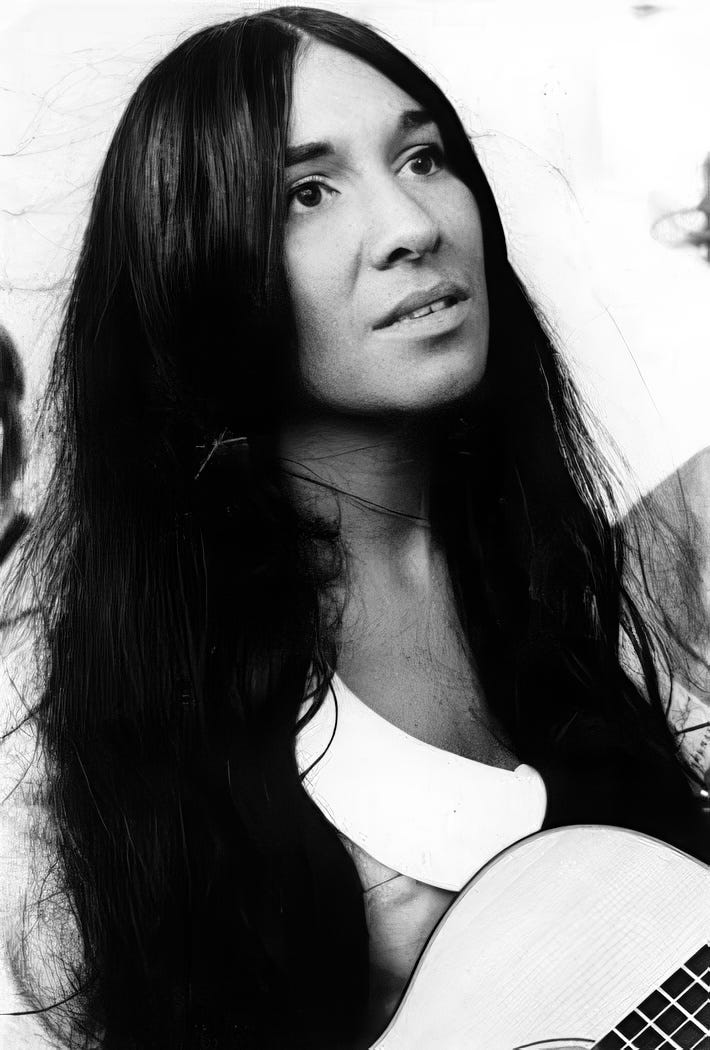
I’ve never been fond of erasing people.
Scratch that—I’m flat-out against it.
Especially those who carved something beautiful out of life’s raw material, stitched their souls into the seams, and handed it over to the rest of us as art. Sure, there are scoundrels in the arts—same as anywhere. You’ll find your pickpockets, prophets, and panderers across every stage and screen. But when someone does something singular—something you can’t fake, can’t replicate with an AI prompt or a hot mic ought to count for something. Ought to weigh on the scale before we bring the hammer down.
Buffy Sainte-Marie was one of those singular voices. Operative word: was.
The takedown was swift and surgical. Awards revoked. Honours stripped like old wallpaper in a renovation of truth. She didn’t stumble into disgrace—she was thrown there with force. There were cries of fraud, of stolen heritage, of a lifetime lived behind the mask of another people’s pain. In Canada, we’ve seen our share of scandals. Conrad Black still has cocktail parties—radio hosts who’ve done worse walk among us, smiling behind studio glass. But Buffy’s sin, we were told, was different. This wasn’t groping or grifting. This was identity theft on a sacred level—absconding with a bloodline.
Yet, here's the part no headline dares to hold onto:
Two friends of mine—Neil Chapman and Chris Birkett—men who’ve worked in her orbit, who’ve sat beside her at the piano, behind the board, in the quiet aftermath of takes and tours—they don’t buy it. They speak of Buffy with reverence. Of her generosity. Her integrity. They’ve seen behind the curtain and still choose to stay.
That, to me, speaks volumes.
So, when publicist Eric Alper called me back in 2017 and asked if I wanted to talk with Buffy, the answer was already in the air—“Hell yes!” There are interviews you schedule, and there are ones you chase because they matter. This was the latter. Not just because of the music, though Universal Soldier still hits the gut like a sermon, but because she belonged to a specific moment in time. And that time belonged to us.
I was graduating from high school in '64. Vietnam was a black cloud on the horizon. College loomed. So did the draft. We huddled under the voices of Dylan, Baez, and Country Joe—our resistance choir. Barry McGuire warns of a clock running out. Buffy’s voice was sharper. Clearer. A scalpel where others used a hammer. She didn’t just sing against war—she indicted it.
Talking to her felt like tuning into an old frequency. My mind toggled between black and white and Kodachrome. One foot in the analog past, one in the pixelated now. The day we spoke, Keith Richards posted a photo—him and Marianne Faithfull, rosé wine in one glass, breakfast tea in the other. Icons frozen in a casual afterglow. It reminded me that time doesn’t pass—it piles up. Like unsorted laundry. The Vietnam War. JFK. MLK. They’re still in the hamper. Still stained.
And here was Buffy—still scrapping. Still speaking hard truths. Still fighting the long war against injustice with a voice that refused to crack.
Now? She’s mostly silence and shadows. The institutions erased her with such speed you’d think memory was a whiteboard. But I remember. And I’m not erasing a damn thing.
Because sometimes history needs an asterisk. And sometimes it needs a defence.
Bill King: It was only a few months back, and the discussion was, where are the songs or recordings that speak of now?
Buffy Saint-Marie: I tell you, I had the same thought, Bill. I was wondering, with all of the great songwriters, are they deaf to what’s going on? Or are they blind to how they could help? Where are those songs? I don’t know. They are out there. My intent with [the new album] Medicine Songs was to corral all the songs, whether super upbeat or outright protest songs – songs addressing today’s issues. It doesn’t matter if somebody was writing the truth – pick a time – in the 1300s with Rumi telling the truth. It doesn’t matter where the songs come from when you are dealing with the classic issues of history, especially colonialism. Those issues have remained the same. Oppression, war, greed, one-upmanship, the pecking order – these things are not human nature. They are choices we make with every generation in every country, every day. We can make things better if we try.
B.K: Back in 1980, I was on a cross-country plane flight, and sitting next to me was civil rights activist and folksinger Odetta. Ronald Reagan was recently elected president. Over the next few hours, we shared our fears and discussed recent gains made in human rights, the war on poverty, and how they were suddenly rolled back. There was this sense of doom, going from a Jimmy Carter to Reagan, as there is now, from Obama to Trump.
B.SM: In your story, there is an excellent lesson right there. These things are cyclical. We have been through “bad” leadership before. We've been through the confusion, and we’ve seen people come out of ignorance and be very surprised at what has been going on behind the scenes and out of sight. We have done this before, been through it before, and we will survive and survive again.
What I would like to conclude is that the good news is that more people are now aware of the bad news, which is a positive development. It’s upsetting to hear troubling news, and there’s plenty of it, but the news that often goes unreported is the good news that's also happening in the world. So, don’t ever forget that. If it bleeds, it leads in the media. Flag-waving, bad news, blood, scandals, politicians; these are all lead headlines. Besides all that, incredible things are happening in communities.
One of the best things happening in communities today is that people are opening their eyes and ears to find out what’s going on. I’ve dealt with a lot of that in my life.
B.K: I think we are having a real conversation now. Gloria Steinem recently said she couldn’t believe the level of activism out there. Do you see this differently than, let’s say, 1964?
B.SM: That’s right, and it’s good, and yes, things do come to a resolution. It does take a village. It’s not as though the media or politicians are going to do it. Or the bankers are going to stop being greedy, or people who like war are going to stop making flags, boots and uniforms. Those things are only contributions to the perfect storm. If you have ever read John Horgan’s book, The End of War – it’s a slim little book, 4” x 5”- it’s incredible. It points out that it takes a whole lot of people not paying attention to corruption to take over truly. There is a significant amount of bribery currently. In Hollywood, we see it in the way women are treated. Everybody’s known all along. However, there is a significant wave of unity in making changes. There was a time, don’t forget, when everyone said women would never get to vote, and they also said you’d never put an end to slavery. They said you’ll never get businesspeople to stop smoking on airplanes, yet it can’t be done. You know, we can do these things.
It’s surprising if you haven’t been watching. It’s not surprising if you've been paying attention. The bottom line is that we can do this. We can make our countries better in the day and age of maybe too much media. We are all publishing and broadcasting on the Internet. We are all part of the same human race and have experienced poor leadership before; we can do it again.
B.K: More about ‘Medicine Songs.’
B.SM: I attempt to put all these songs on one album. It’s all-new recordings except for one song. It’s a generous album in that I wanted a 20-song album, and of course, that’s not going to fit on vinyl. There is a vinyl release too. We've included twelve songs on the CD, and a link is provided for the additional tracks. You buy the CD, and it arrives at your doorstep. There’s tremendous positivity in this recording, like “Carry it On,” “You’ve Got to Run,” “Star Walker,” and “Soldier Blue." It is another way of looking at North America through indigenous eyes which is quite different from that kind of “Nazi chant” of nationalism that is quite different from what I call ‘matriarchism’ or loving your mother country. There are also powerful songs, not only “Universal Soldier,” but also newly recorded. "Now That the Buffalo Is Gone,” – in your neighbourhood, people might remember the building of Kinzua Dam and the flooding of the Seneca Reservation. Some songs go back to the sixties, through to songs I wrote recently. “War Racket” – that’s going to stand your hair on end because that is about what’s going on today. We live with the ‘war racket’ every day, and we tolerate it.
B.K: Your version of “America the Beautiful” and, of course, the version that comes to mind mirror one another. What happened first, the vocal or the choice of instrumentation?
B.SM: There is a man whose name is Commander John Herrington, who is the first native American astronaut, and years back, he was to get his first ride, and NASA bussed in a whole bunch of people from the Chickasaw Nation, where John is from, and they invited me to sing. I wanted to sing something inclusive of all the different kinds of Americans there are. Not the "Star-Spangled Banner," which is often associated with war. “The bombs bursting in the air.” Everybody I talk to thinks “America the Beautiful” should be the national anthem. I added a middle part and an introduction that says there were Choctaws in Alabama. Chippewas in St. Paul - Mississippi mud runs like a river in me. America, you are like a mother to me. It’s just a whole other look at a legacy melody written by Samuel Ward and Katharine Lee Bates. Numerous versions are available online. Some are racist, others are nasty. At the other end of the spectrum, some are about the natural part of America.
B.K: The folk music of the ’60s had a deep connection to Appalachia. It was that sound–mix of Irish, Scottish, African American, Indigenous peoples and others who found refuge in those mountains. They were on familiar ground there. Did that in any way connect with you?
B.SM: I wish I could say yes. You know, when it comes to a lot of the people you mention, especially the people we associate with 1960s’ folk singing, like Joan Baez, Ewan MacColl, Pete Seeger, they are really from that Scotch/Irish/ British Appalachian tradition. Just like in the history books, everybody thinks of the slaves and Africans as slaves, but nobody knows the history of enslaved native Americans. It was only a few. In 1500 years of North American contact with Europeans, millions of native Americans were either slaughtered outright or enslaved – women uniquely branded on the face — tens of thousands of women—little girls and boys sent to the Middle East and the Philippines. There’s a book called The Other Slavery by Andrés Reséndez that's worth reading. It will break your heart. It’s about the history of native American enslavement. People aren’t aware of that.
I was on a Pete Seeger television show, and we were also supposed to come out for a European-style finale and sing a version of “This Land Is Your Land, This Land Is My Land." I couldn’t do it. It was such an obvious thing. Woody Guthrie, Pete Seeger and all the other people who were participating in that had zero Native American conscience. They had no idea how that would affect the Native American people watching. No, this land used to be my land. This land is no longer mine. It belongs to oil companies and other great entrepreneurs and thieves who have taken over the native land over the past 1500 years. I wasn’t mad at Pete Seeger or Woody Guthrie. I couldn’t sing the song. I did take the opportunity to let Pete know, right or wrong, why I was crying that day. It was about the fact that Americans, by and large, haven’t had a chance to be educated, yet here it is, many years later, and more people are aware of Standing Rock or other issues because of It. It never goes fast enough, but we do learn.
B.K: How are we doing here at home with Trudeau?
B.SM: Well, certainly better than the last guy. There are still many questions unanswered, as there always will be. I was recently in Alberta, and oil companies are struggling. I’m reconsidering my stance on the issue. Oil companies are our brothers and sisters, too, although I am divesting from all fossil fuels. As far as investments go, I am green. When oil prices dropped to a dollar a barrel, the people in Alberta, an oil-rich region, could no longer afford to support the same level of activities at universities, music festivals, or hospitals. A significant portion of that loophole tax money was going to places that are now no longer going to have funding. The idea of green energy not being the enemy of fossil fuel and trying to get the oil companies turned around and no longer poisoning us and future generations – they have to be a part of this. Those of us opposed to fossil fuels and the further development of fossil fuel industries must find ways to acknowledge this. We are brothers and sisters to those people, too, and have to turn them around.
B.K.: Did you catch any of Ken Burns' series, Vietnam?
B.SM: I did watch some of it, but not all of it.
B.K: Any thoughts?
B.SM: It’s not as though I didn’t know. I was watching with people who didn’t know about the Vietnam War, and I was watching them. They were so surprised. It was so horrific and corrupt, and it involved a huge financial deal.
B.K: Both of us are of a generation whose lives were impacted by this, and it placed a hand on us. From this perspective, I thought Burns backed off from the influence of activists and protesters. They are there, but even the two or three exiled Americans who spoke spoke as apologists and were not representative of the 150,000 Americans who crossed the border to Canada. I don’t think he captures the severity of the resistance.
B.SM: I’m glad to hear you say that. I didn’t watch the whole series and wouldn’t have been aware of that omission, but bringing it up is a good point. It was resistance and aboriginal resistance, too. It didn’t just start with Idle No More or Standing Rock. It’s been going on for five hundred years. Ken Burns - wake up.
B.K: I had a good look at his sponsors' list and could see why Burns omitted and softened parts. He’s planning for his next project. Vietnam is an expansive project, done magnificently, as if Stephen Spielberg had gathered all the footage and edited it together to give you a sense of what it was like to be in those combat zones.
B.SM: We helped end the war in Vietnam and put Lyndon Johnson out of business. Many overlook the fact that war is a business. A lot of people are “invested” in flags and boots, and uniforms, like it says in my song “War Racket.” People don’t realize how the airplane companies, the uniform companies, the boot companies, and the energy sector all contribute to it. If we continue to raise awareness, things will change. If we go to sleep, we get that.
Lastly, going back to Reagan. He chose to shift tax dollars, the nation’s treasury, and finance a massive arms buildup and outspend the Soviets. In doing so, he robbed inner cities, and America fell into urban decay.
He took the money out of Sesame Street, and it couldn’t travel anymore and became a New York show. Before Reagan, I took Sesame Street to Taos Pueblo - to Indian reservations. We did a lot of that kind of programming. Things changed. When Reagan came into office suddenly, there were mental patients on the streets because they were closing down facilities. I’m glad you said that. People have forgotten how “Trumpish” the guy was regarding the things he was supporting. We’ve got to find solutions, day by day, and we can do it!
Truly appreciate Ray - there are thousands of Substack newsletters. I try not to chase the crowd and focus on the moment and the people who have shaped our lives.
I think it's an absolute outrageous indignity what they did to Buffy who did more for indigenous rights than anyone ever in Canada.To be shamed like that and stripped of her accolades is an injustice of the highest order and one that should never have happened to a brilliant singer, song-writer and brilliant advocate for indigenous people whether she was blood related or not. I will always support Buffy one thousand percent and will sing her praises which she so rightly deserves. Good on ya Bill for feeling the same.