


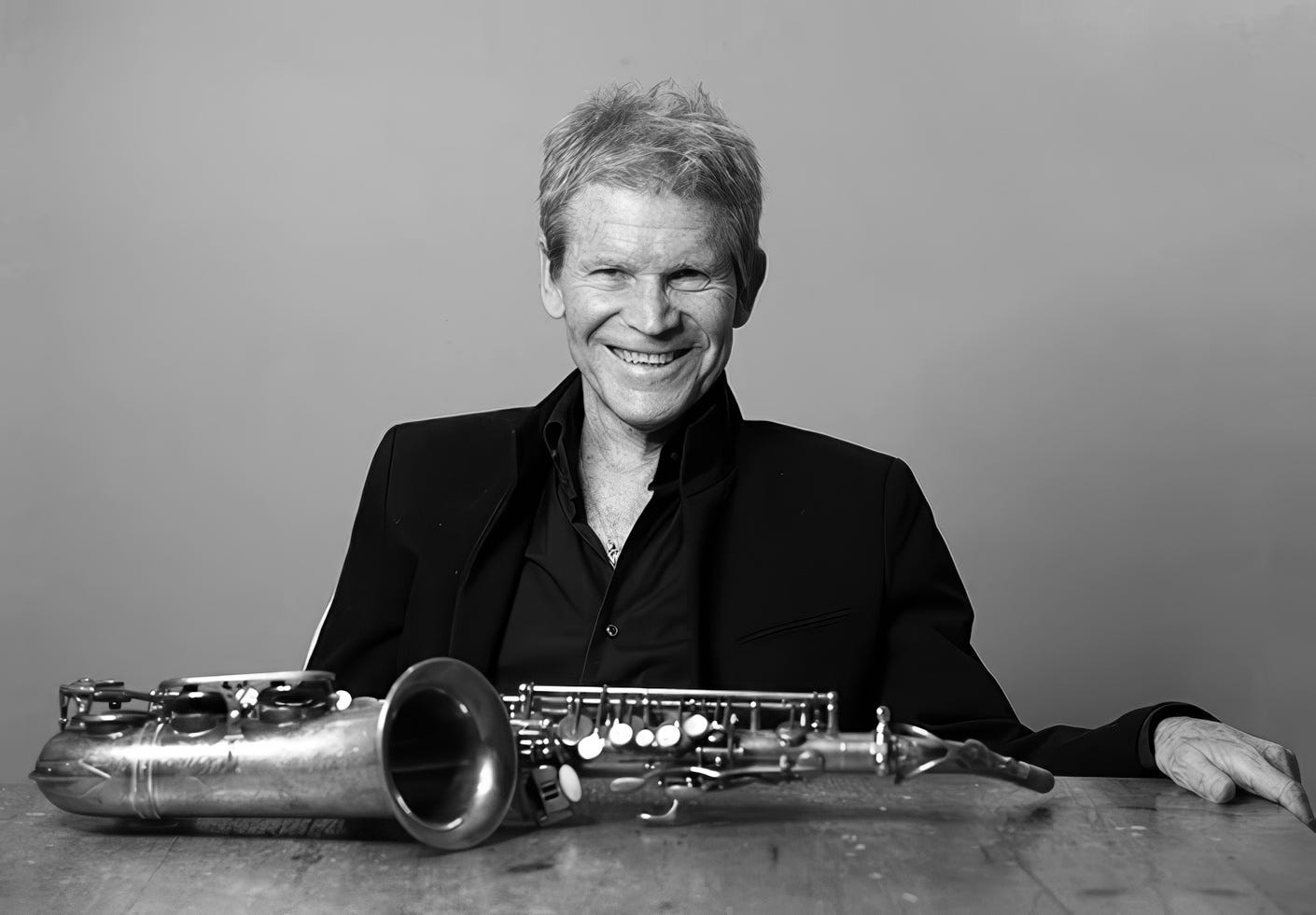
Certain men are born with the sound of a city in their chest. You can hear it in the slink of a midnight cab on 7th Avenue, the hiss of steam vents along the Harlem curb, the ghost moan of an A train car — and David Sanborn carried all of it inside an alto saxophone.
He wasn’t built for music — not at first. Polio crippled him at three, and the horn was therapy. Something to breathe into. To fight for. To rage against a body that wouldn't bend. What began as a rehabilitation device in suburban St. Louis turned into a siren's wand — one that would one day bend genres, blur lines, and compel royalty from Bowie to Joni to Stevie to let him blow soul into their songs.
Sanborn never played jazz like it was jazz. He played it like life on the wire — gritty, impolite, gorgeous. Those who labelled him “smooth” missed the point. They saw the polish, not the pulse. Underneath the lush studio veneer was a working-class wail: part Memphis grit, part Harlem nocturne, and part St. Louis bar fight.
By the late sixties, he had crossed over — not in the musical sense, but literally — into the dens of rock gods and R&B kings. Woodstock? He was there. Young Americans? That’s his sax on Bowie’s gospel swagger. Wonder, Springsteen, the Stones — he carved a place not just in the charts but in the bloodstream of the American soundscape.
His solo career was a masterclass in pop ambition and jazz rebellion. Taking Off, Voyeur, Double Vision — albums that flirted with the mainstream but bore his fingerprints: mournful, urban, urgent. He didn’t imitate Coltrane. He didn’t chase Parker. He let the church and the back alley argue it out in each solo. That’s what made him unmistakable.
Then there was Night Music, that late-’80s fever dream of a television show, hosted with the elegant mischief of Jools Holland. Sanborn sat like a conjurer, pulling together a parliament of sounds: Sun Ra next to Sonic Youth, Al Green crooning as Miles' ghost passed through. It was the only place on TV where actual music still breathed, unfiltered.
The irony is that Sanborn was never truly comfortable with the stardom, the “Sanborn sound.” It boxed him in. But he kept playing, even when cancer came knocking in 2018. He played through pain, prognosis, and the ticking clock — because the saxophone wasn’t an instrument for David Sanborn. It was defiance. And it was love.
On May 12, 2024, the horn went silent, but not the sound. The sound—that city-slick cry, that jazz-punk R&B whisper—hangs in the air still, in every late-night FM dial scan, in the memory of a note that felt like a prayer on fire.
David Sanborn didn’t just play. He testified. And we, the lucky congregation, believed.
From the vault - we spoke in 1991.
Bill King: Another Hand differs from other albums, emphasizing melodic flow rather than relentless rhythmic drive. Was this change intentional?
David Sanborn: I just wanted to make a different kind of record. I’ve made so many records in the same vein. The last four or five are similar in that they were synthesizer-based R&B funk records. It’s like anything else; sometimes, you must step back and do something different. You get that reaction from a lot of people in various fields. Sometimes, they want to do something that inspires them in another way. I needed to take myself outside of what I usually do and into a primarily acoustic setting.
B.K: Did you ever second-guess yourself during the recording process and contemplate adding a groove number for safety?
D.S: No. This may not sound smart, but I didn’t put groove tunes on the other records to make them commercial. I did that because that was the kind of music I wanted to make. I like fun music. Like Ray Charles, James Brown was a significant figure in my life. That music means a lot to me. It wasn’t necessarily a rejection of that; it was to make or do something I felt was consistent. Every album has a particular personality and a continuity you try to maintain. To throw something in there where it doesn’t fit seems odd to me. I wanted this album to have a particular kind of sound.
B.K: Was there much pre-production?
D.S: In a certain sense, there was quite a bit. Hal Willner, the producer on the bulk of this material, was also the music producer on the TV show I called “Night Music.” During the year he was the show's music producer, we had an opportunity to audition different musical concepts. When Charlie Haden was on the show, we talked with him and thought about what we tried out. We had a chance to formulate what we wanted to do with this record.
B.K: You’ve composed with hooks without being condescending; is this the way you have always heard your music?
D.S: It’s probably the way I relate to music. It’s a popular music form. As a writer, I’ve come out of that era, although I don’t consider myself a prolific writer. In my rudimentary way, that’s probably what I relate to.
B.K: There is an assortment of writers represented on Another Hand; were you introduced to the material through the show?
D.S: Not the tunes themselves. I had known Charlie Haden for quite a while, but had never met Bill Frisell. I met Bill and Terry Adams on the show. We had an opportunity to talk about the record, and I said, “Someday, I want to record with these guys.” It’s what musicians often say to each other, but it doesn’t happen half the time.
B.K: I can honestly say I’ve never heard any of those bland background singers chanting love slogans behind you. Have you purposely avoided those types of instrumentals?
D.S: Yeah. That kind of smacks of elevator music to me, which is why I’ve avoided it. I must confess, though, I have done it on occasion. I did a song called “Neither One Of Us,” which was a hit for Gladys Knight, but I always loved that tune. Luther Vandross was involved with me on it. He wrote and sang background.
B.K: You took up a wind instrument as part of physical therapy to overcome a childhood illness. Did you ever imagine the alto saxophone would bring you so much more in life?
D.S: No, I never really thought that. My life is still kind of unfolding. On a physical level, it probably helped me and my mental health; it gave me something I could relate to. Athletics were more or less out for me; it’s not that it was impossible, but difficult.
B.K: There’s incredible emotion from each track on Another Hand. Do you go through periods when melodic lines seem to flow endlessly?
D.S: When you play, you bring the sum of your experiences up to that point. You react to that moment, whether it’s the melody or you’re improvising or whatever it is. In a certain sense, what you do is develop your reflexes. And part of that is training your ear and building your ability to react appropriately to a musical situation. The piano player waits for half a beat before playing a chord; you immediately respond to that situation. I think a lot of it has to do with the context you are in. You can choose to create those kinds of contexts. I was looking for a particular type of atmospheric nighttime feel for this record.
B.K: You’ve identified Hank Crawford, Jackie McLean, and Charlie Parker as crucial influences on your playing style. Where does someone like King Curtis come into play? Both of you became essential figures in R&B through your numerous appearances on recordings and recognizable sound.
D.S: For me, Hank Crawford is the primary influence. King Curtis was also a significant influence, but it’s easier for me to pick out one: Hank Crawford. He was the first guy I heard. As for everybody else, I heard them all my life. Every great saxophone player influenced me, and I continue to listen to them all. I’ll go through periods where I‘ll listen to many Jackie McLean. Certain people are consistently more rewarding to listen to and learn from, like Charlie Parker and Sonny Rollins, the acknowledged masters, like Coleman Hawkins, Lester Young, Stan Getz, and Phil Woods. I listen to different people to learn other things. There are specific things that strike you about individual players. For me, it’s Sonny Rollins for his sense of humour, time, and ideas.
B.K: Did you play in R&B bands while growing up in St. Louis?
D.S: Yeah, I was really into rhythm and blues.
B.K: Were you called upon to lift horn lines off the R&B hits of the day?
D.S: Most of the rhythm and blues bands I played in were reasonably loose. If it were essential to the tune, you’d lift it. In the early stages of playing, you copy people. You copy solos and learn them. That’s part of what you go through as a student of the instrument. You understand what other people do in certain circumstances. From that, you develop your style or way of reacting, but it’s always based on the past. It’s based on what’s gone on before you. Knowing that is very important.
B.K: The Stones' tour in 1972-73 with Stevie Wonder must have been an eye-opener for a young musician like you.
D.S: I’d been playing with Stevie Wonder about a year before. We were opening for the Rolling Stones, and they were at a certain height of fame and insanity. A lot was going on around them.
B.K: Wasn’t this the significant change for Stevie Wonder, his break from the past?
D.S: He was coming into his own. It was about when Music of My Mind and Talking Book came out. It was when he transitioned from Little Stevie Wonder to Stevie Wonder. It was an excellent band. It was great playing with Stevie because he’s such a powerful singer. The time is superb. It’s like being on stage with this nuclear reactor. Ray Parker Jr. was on guitar.
B.K: How would you describe the years spent working with Gil Evans?
D.S: I learned a lot from Gil. I learned about playing in an ensemble, laying out, and the importance of space in playing. If I could think of one thing that is as important as the notes you play, it’s what you don’t play.
I bought all his recordings. Funk and jazz. His tv show was the best. Sanborn had his slice of fusion. Loved his work.
So kind of you.