


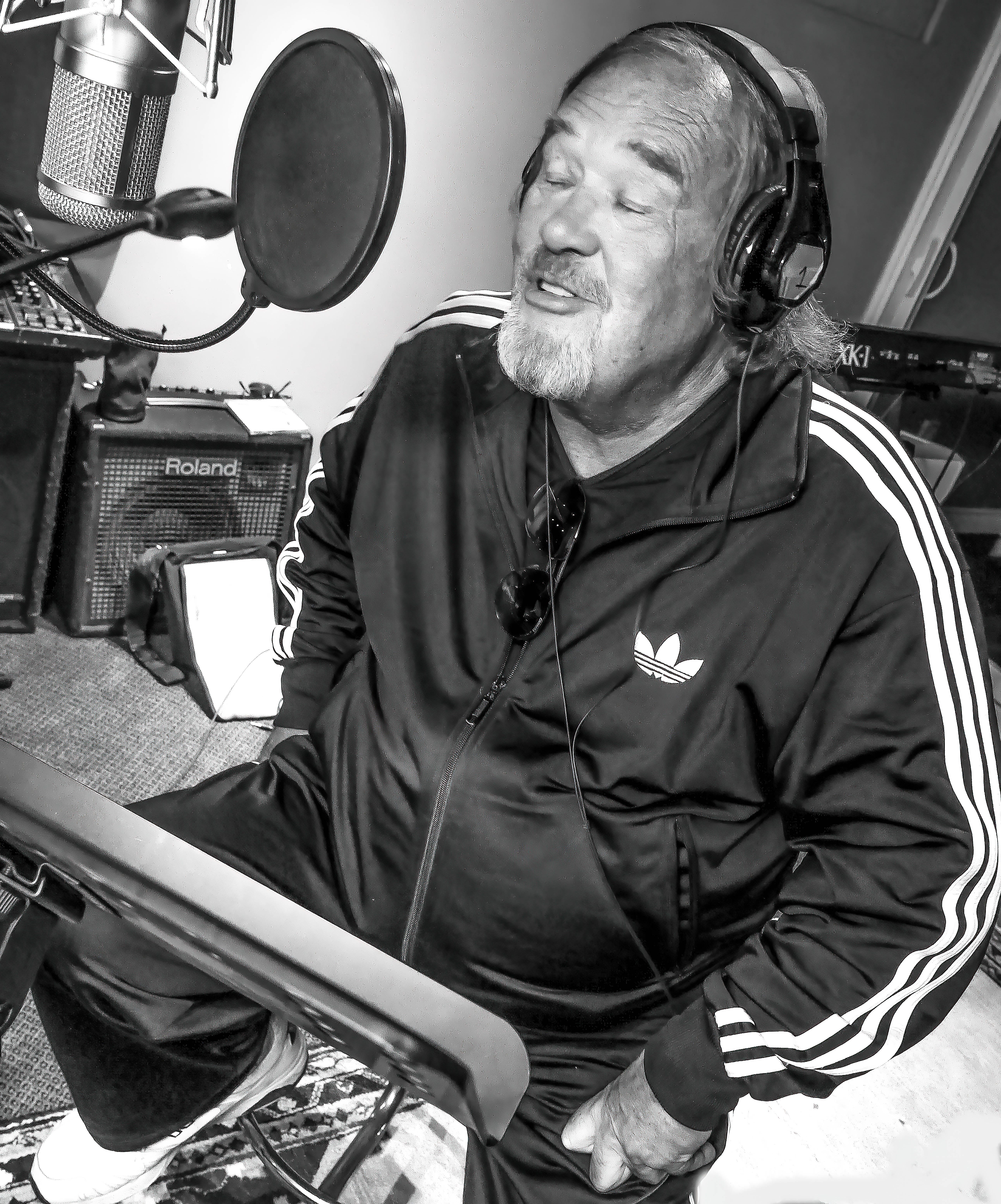
Bill King Photography
I first met David Clayton-Thomas in the late 1960s on a whim, like so many New York encounters back then—half accident, half fate. The Bitter End was always open, always glowing with low-wattage possibility. There was a Hammond B-3 parked onstage, probably waiting for a rehearsal, and fellow keyboardist Moogy Kingman goaded me into jumping on the spinet. Sly Stone ambled in, started teasing the drawbars, and I slid into his groove. We traded phrases until I caught the nod—that sideways smile only Sly could give.
As I stepped offstage, I was introduced to a big-shouldered singer with serious presence—David Clayton-Thomas. Someone whispered, “That guy can sing.” I hadn’t seen the last of him.
Fast forward nearly five decades, and we’re sitting across from each other again—me with the recorder, him with that same fearless candour and a voice as seasoned as oak. David had just turned 74 but carried himself with the same righteous fire that lit up Spinning Wheel and Lucretia MacEvil. Below is our whole conversation—uncut and honest. We covered Greenwich Village, the café circuit, Duff Roman, Sarah Vaughan, “Nature Boy,” and the magic of getting it right on the first take.
Ronnie Hawkins used to call Thomas “whip ass.” Known for his pugilist encounters with aggressive bar boys. “He’d scare the crap out of Roberto Duran when he’d get into one of those moods,” Hawkins would say.
Latter-day Thomas, turning 84 in September, is still fighting the good fight, posting daily reminders that Trump is no Nixon - here on a four-year day pass from Satan.
Bill King: Mr. “Bustin’ Loose” is in the house. He’s won 3,400 Grammys – untold Junos. When you think of the history of Canadian funk, soul, and blues, you think of David Clayton-Thomas.
David Clayton-Thomas: We go back a long way, Bill.
B.K.: The first time we crossed paths, and I’m sure you won’t remember, was one afternoon at the Bitter End in Greenwich Village (1967). I have no idea why I was there other than I used to hang around the place a lot. There was a Hammond B-3 and a piano on stage. Sylvester ‘Sly’ Stone started playing with the drawbars on the organ, and I decided to play some piano, and you walk in. Someone says that DCT from Canada - the guy can sing.
DCT: We were the house band at the Café Au Go Go right across the street. I lived on a six-floor walk-up on Thompson Street right around the corner – that was my neighbourhood. We were too big a band to play the Bitter End. We played the Au Go Go for months.
B.K.The first time I caught Blood Sweat & Tears, they played the Anderson Theatre as a quartet on $1 Tuesday night. You rarely knew who would be on the bill – the surprise performers – caught Simon & Garfunkel that way. Al Kooper was leading BS&T. How did you fall into the band?
DCT: I had been gigging around Greenwich Village for about two years. I pretty much hitch-hiked from Toronto after having three #1 records in Canada – that’s how much money I was making those days in Canada. There wasn’t a music industry here in the ‘60s – it just didn’t exist. For two years, I starved in New York like everybody else. Worked all the clubs: the Bitter End, the Gaslight, the Café Wha? the Four Winds – you know them all. Played alongside, you know who; Jimi Hendrix, who was then Jimi James, James Taylor, and Carol King; starving musicians playing those little clubs. It was not unusual to run into each other.
I knew some of the early guys like Randy Brecker, Bobby Colomby; we played little club gigs together, across the street or following each other. It was Judy Collins who suggested to Bobby Colomby, after Al Kooper had departed the band, that there was a singer he should listen to. I was playing at Steve Paul’s Scene on 46th Street, even having the house band there. So Judy Collins, Jim Fielder, and Bobby Colomby came in and heard me there, then asked me to sing with the group. Unfortunately, my visa had expired; truthfully, I never really had a permit – I was essentially there illegally and was being politely asked by the government to return to Canada, so I did.
A couple of weeks later, Bobby calls me and says they want to bring me back. I asked him if they could do it legally. Columbia Records hired a lawyer to handle the case and secured a temporary visa for me. I returned, and we started as the house band at the Café Au Go-Go.
B.K.: Those days’ musicians got out and caught each other performing at night. You would look out into the audience and see Stevie Winwood or Donovan.
DCT: I don’t want to sound old-fashioned, but the industry died when it moved to Hollywood. In New York, it lived in eight square blocks. In Greenwich Village, from McDougall Street to Bleecker to West Broadway – in that little block, you could walk down any Saturday night and see Jimi Hendrix, Dave Van Ronk, Tim Hardin, and Todd Rundgren - all played what was called basket houses.
You’d stand in line in a funky little club that seated about twenty people. There would be a rickety old piano and maybe a microphone at the end of the room. The artist would stand in a single line down one side, with guitars in hand, and you’d be allowed to sing a tune or two. You’d do a couple of songs and pass the basket. That’s how we survived and kept pizza money in our pockets. Several musicians would get together and rent a room, and we’d share. We’d divvy up the time – you get it to three in the afternoon; I get it at seven at night – three or four different musicians living in the same place. With Blood Sweat & Tears, everything exploded in no time — two hundred and fifty dates a year for forty years.
B.K.: I was reading the list of songs on the back cover of your new side, Combo, and saw “September Song” and thought, David’s in my wheelhouse now. I see “Stardust,” and feel the Willie Nelson version must have come to mind.
DCT: I based mine on the original Hoagy Carmichael version. He played it like a funk blues. “September Song,” I heard by Sarah Vaughan, was the version that nailed me.
When we recorded this album, we didn’t come into the studio with a list of songs. Nothing preplanned. We’d arrive in the studio around 11 a.m. and gather around the big Bechstein piano and toss tunes around until we found a new groove – “September Song” is a bossa nova – then everybody takes their places – cut! Vocals are recorded live with the band; everything is done in real-time. It’s incredible when you do that, how many first takes do you keep? If you start thinking about it, it’s too late.
B.K.: Mark Kieswetter’s piano supports you wonderfully, the way he colours harmonically.
DCT: He’s a singer’s piano player.
You’ll like the duet - sort of a fifties schmaltzy song called “The Glory of Love” with my friend Genevieve Marentette, and she nails this song. She’s gorgeous, sings – I’ve mentored her for a long time. She attended the same school as my daughter. When she graduated from Humber College, I could see this raw talent in her.
B.K.: How do you recognize talent like this?
DCT: I don’t know, but you know when it’s not. It’s the little hairs on your arms that stand up when a particular singer sings or when nothing. I don’t know what ‘it’ is anymore. I’ll tell you a quick little story of when I went down to Kleinhans’s Music Hall in Buffalo when I was young and saw Ray Charles for a Christmas Concert. They led Ray out – the place was packed – he sat down at the piano and struck possibly a ‘sus 5’ chord and went “Jingle Bells,” and I went – “woop” - looked around and people were crying. That’s something you can’t measure or explain. Someone once told me a Brazilian needs three things to live: food, water, and music. Without either, they won’t survive. Music is their DNA—the same with Cuba.
B.K.: Your first records – Duff Roman got you out there. He said you were a tough guy. You wanted to be on stage and the other bands off.
DCT: They were rough clubs. I do and don’t miss the strip. That’s where the young musicians of Toronto developed the Toronto Sound. We had a strip of bars from Queen Street up to Gerrard. Probably about ten or fifteen clubs, the Colonial, Le Coq d’Or, the Friars, the Zanzibar – and we’d bounce from club to club. In the states at that time, there was a severe colour bar – you couldn’t go from here to Detroit with a mixed band of blacks and whites.
The big acts from Detroit and Chicago played in black clubs on the other side of town so it didn’t take them long to discover there was no color bar in Toronto, so they’d come up and play the clubs on the strip to mixed audiences – they were idolized by the local musicians and got some respect. You’d not only see the Ronnie Hawkins band, or my band, you’d see Muddy Waters, B.B. King, the Temptations, Ike and Tina Turner, Miles Davis - it was continuous exposure to this. We’d do a set at the Friar’s Club and run next door to see the James Brown band. That informed the Toronto Sound.
B.K.: Making records today.
DCT: The brilliant A&R men, John Hammond and Ahmet Ertegun, knew how to select the right artist, the right song, musicians, and make outstanding, great records. That’s pretty much gone.
B.K.: Is that what happened at the beginning of Aretha’s career - a mismatch?
DCT: They were making big syrupy ballads and such...
B.K.: Then she gets with Atlantic – matched with a great producer, songs and musicians, and it all clicked – the same for Ray Charles, although he had more of a say in his recordings.
DCT: He was somewhat of a visionary. He figured it out twenty years before it happened: that country music would become huge. That Contemporary Sounds of Country Music he did in Nashville shocked the world.
B.K.: What made you include the song “Nature Boy” on Combo?
DCT: I’ve loved this song since I was a kid. I heard a Nat ‘King’ Cole Version with him and just a guitar. It was gorgeous, so Ted Quinlan and I tried to recreate that feeling with some shading from bassist George Koller, a little piano from Mark and Ben Riley, and drums.
B.K.: You’ll be performing at the Sing! The Toronto Vocal Arts Festival, May 28 at Glenn Gould Theatre.
DCT: I’ll be guesting with Cadence – my favourite a cappella group that has recorded with me a couple of times. Brilliant musicians.
B.K.: How much time did you spend in the studio recording Combo?
DCT: A week to ten days. Four or five days a week.
B.K.: Do you like working in a small space like that?
DCT: The album, compared to most, was made quickly, off the floor. Even the vocal with Genevieve was face-to-face, live off the floor with the band in the room. That means there is minimal post-production on the album. It’s just a matter of tweaking the EQs and balancing. Some records, you go in and spend a month and six months in post-production overdubbing and editing. There’s almost none of that on Combo.
Saw Joni Mitchell, Neil Diamond, Electric Flag there in 60s..
Great article. I still go to the Bitter End when they hold the Songwriter's Initiative; open mic for one original song per musician. Fabulous night of talented entertainers.