


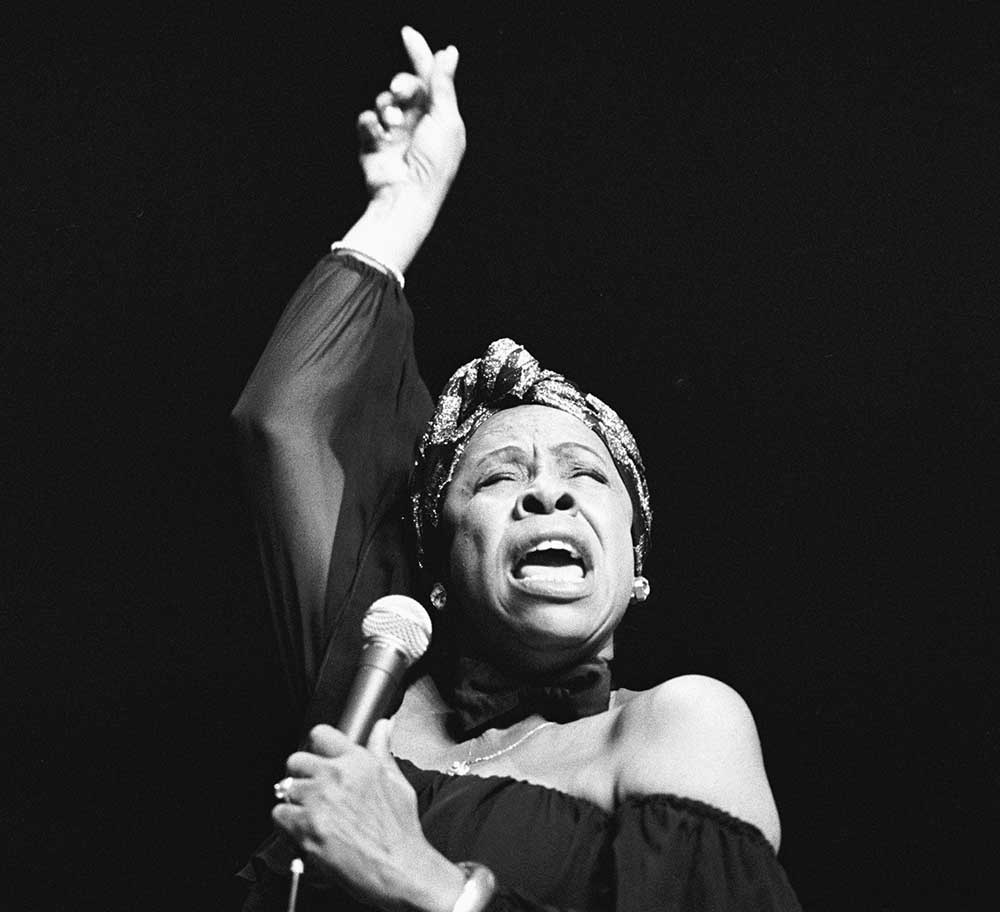
Somewhere in the fogged-over '90s, when jazz still flirted with the fringes of mainstream acceptance, my buddy Marvin from Dayton—hustler of dreams and purveyor of spontaneous combustion—called me up with the kind of idea only two broke jazz junkies would believe could work: a jazz cruise on Royal Caribbean. Yeah, a floating festival. Jazz at sea. Salt air, swing, and sopranos. Neither of us had money. What we did have was Betty.
That’s how you know this was real—from jump, the first name on the manifest was Betty Carter. The Betty Carter. Goddess of phrasing. High priestess of the pause. Marvin and I? Certified Carter Crazies. We played her records backwards if we thought there was more wisdom in the silence.
Marvin scrounged up some seed cash. No one asked too many questions. I called in every favour. Diane Reeves said yes. A few Canadian jazz heavyweights were in. We bought ad space in The Village Voice—I still remember the giddy tremble in my heart when Marvin signed the check. We were sailing, metaphorically at least.
Then the phone rings.
“Bill, tell me something. How big is the boat?”
It was Betty. Her voice—low, precise, with that conspiratorial lift at the end—sounded like she was asking about a murder weapon.
“Betty, it’s not a boat, it’s a cruise ship. Holds about twelve hundred passengers.”
Pause. “O.K.”
A week later.
“Bill, does the boat rock side to side? Out there in the high seas?”
Now I’m hearing it. Fear. The woman who could demolish a rhythm section with a glance, who restructured American song with a syllable, was afraid of waves.
“No, Betty. It’s not a boat. It’s a big ship. It glides.”
More ads. More calls. I hounded DownBeat, Jazziz, Jazz Times. Marvin’s pacing his living room like he’s waiting for a baby.
Then the final call.
“Bill, I don’t know about this. I’m hearing hurricanes. People die out there. I think I’m gonna pass.”
Click.
That was it. Betty bailed. And so did our dream.
Two weeks later, the Atlantic howled with one of the worst hurricane seasons in modern history. Eleven named storms. Eleven reasons to cancel. Betty Carter, as usual, was ahead of the downbeat.
I should’ve known. Betty was never just a singer. She was a prophet of tempo, a clairvoyant of musical mood. She didn’t walk into rooms—she rearranged their gravity.
In 1961, she and Ray Charles—two seers of soul—recorded Baby, It’s Cold Outside. The song hit #1 on the R&B charts, but it wasn’t the song that mattered—it was them. Ray, with that gospel moan soaked in Georgia clay, and Betty, cutting through like fine crystal, both in their late 30s, are finally comfortable in their genius. While Ella and Louis had planned chemistry, Betty and Ray had alchemy—a once-only blend of joy, flirtation, and grown-folk play.
Years later (1990), I sat across from her. Just the two of us. She had that kind of laugh that made you forget how formidable she was. But Betty Carter was never soft. She didn’t lean in—she took over. Ran her label, Bet-Car Records, when most artists were still begging labels to spell their names correctly. She mentored young musicians, not to shape them in her image but to liberate them in their own. Her bands were like finishing schools for future jazz greats. You either rose to her tempo or packed your bags.
Betty didn’t cater to trends. She was the trend. Before “indie” meant anything, she was pressing vinyl on her terms, daring you to catch up.
She died in 1998. The boat never sailed. But every time I play her records, I hear waves. Not of water—but of change. Of truth. Of Betty.
And yes, I still shed a tear—every damn time.
Bill King: Did you learn the basics of theory and harmony when you studied piano at the Detroit Conservatory of Music?
Betty Carter: That came through trial and error. I learned by doing. When I went to school to take piano lessons, I knew nothing about theory or harmony. That's what my parents wanted. They sent me to see if there was any talent there. I had no clue about music or jazz at that point. I didn't even know I would be in this business.
BK: Detroit has produced some of the finest vocalists in both jazz and R'n’B. What makes Detroit such a fertile environment for young singers?
BC: I don't know. Perhaps it's because when African Americans began migrating north, Detroit and Chicago were the destinations they chose.
In the churches we visited, there was a musical richness, all part of the community. When the opportunity arose for singers to make a choice, whether to stay in gospel or leave it, they had a solid foundation and training from the church. Most people got their experience there.
My parents were involved in the church, so I was, too. In the church I belonged to, if you worked in jazz clubs or wanted to become a stage star, you were condemned as a sinner. You were going straight to hell, so naturally, my parents didn't encourage me in that direction.
It was my schooling and the students who encouraged me and motivated me to become a jazz person. Even then, I didn't realize what I was going to become until I heard Charlie Parker, Dizzy, and that whole world of music.
Bebop came to Detroit first. It was one of the first cities in the Midwest to accept bebop. Chicago had not adopted it as Detroit had. We were on it and loved it. We had many notable musicians, including Barry Harris, Benny Burrell, Tommy Flanagan, Yusef Lateef, and many others. Some stayed and died there; others moved on.
In the 1950s, there were numerous clubs in New York, Chicago, Philadelphia, and Boston. That's why bebop flourished at that time; there were plenty of places to work.
BK: Can you still remember your professional debut?
BC: It was in Dayton, Ohio. Snooky Young, who played with the NBC band on the Johnny Carson Show, was in the band along with a group of other kids. He was so handsome--I just thought he was the best. Anyway, I skipped school to go there and work. After a taste of that, I went back home, finished up school, and struck out.
BK: How did Lionel Hampton come upon you? What was the experience like when you worked together from 1948 to 1951?
BC: Lionel Hampton came into town at a place called the Forest Club to play a dance. A friend of mine took me. I wasn't a Lionel Hampton fan and didn't know he was looking for a singer.
When I arrived, I discovered that Winnie Brown was on the verge of leaving the band. The kids around the bandstand asked Hamp to let me sing. He said, "Can you sing?" I said, "Yeah, what do you mean, of course, I can sing." That was my ego, my youth. I got up there and sang, not having the faintest idea he would send for me. Two weeks later, that's what happened.
It was a rough two years, meaning that I fought it all the way. Hampton's band was well organized; it had been in existence for quite some time. Being young and a bebopper, I said to myself, This is not the kind of music I want to be doing. I stayed because of his wife. She saw something in me. I guess I didn't see. She encouraged me to hang in there and do whatever I had to do.
I wanted to sing songs with lyrics and improvise. I didn't realize what was being played was educating my ears. I was a dummy in those days, youth being what it is.
Twenty years later, I looked back, and I saw that Hampton's band was the best one I could have been with at the time, even though I wanted to be with Dizzy Gillespie.
BK: Mary Lou Williams was able to hone her arranging skills in the Andy Kirk band. Did you develop yours with Hampton?
BC: Yes, that is where I learned how to write scores. The guys in the band taught me because I wasn't doing anything. We had four other singers with the band: Jimmy Scott, Jackie Paris, Jeanette Franklin, and Irma Curry. They all had silky voices, and I had the raw edge.
I could improvise at the drop of a hat, and that's what Hamp had me doing. He wanted to be one of the beboppers, too. He was thinking ahead. And there I was, giving off that attitude. I guess that's how I got the nickname Betty Bebop.
BK: One of the greatest ever Christmas songs for lovers is the Betty Carter-Ray Charles version of "Baby, It's Cold Outside." What was the recording session like? There are so much warmth and passion between you.
BC: Scary! Here was Ray Charles, who had just had a big hit with "Georgia," and I was performing in some theatres as part of the show, sharing the same bill with him. We were in Baltimore. I'm talking on the phone, and he walks by and says to me, "Hey Betty, you with ABC Paramount?" I say yes, and he replies, "Why don't we do an album together?"
Well, I immediately hung up the phone. I was scared and didn't think he meant it, but he did. I had to fly out to California all by myself.
Ray had strings and other voices on hand, and I had just one session with him to talk over what we were doing.
BK: Were you familiar with any of the material?
BC: Every song that I sang was new to me. I would never have thought of doing "Two to Tango," “For All We Know,” and all those others. I knew the songs, but I’d never sung them.
BK: Did you take time out to raise your kids?
BC: I never stopped working. The fact is, when I made the road trip with Ray Charles, I had just given birth to my first son. I went on the road with the baby and did 31 one-nighters. This was an opportunity for me to earn some money for my family. I was a young girl getting exposure with Ray Charles. We were getting standing-room-only business.
Both times I was pregnant, I never stopped working. And when I had the babies, I brought them on the gigs. It was a different period. I don’t know if a singer could do that today, but it is possible. You can raise kids and do what you want to do, too.
BK: Did you establish your independent record label, Bet-Car, during this period?
BC: Bet-Car originated as a result of an emergency. In 1964, the record companies got crazy. The whole world of music changed. They were no longer interested in dealing with jazz as they had been before. It wasn’t a fast money maker, so it went on the back burner.
I wasn’t the only person without a label. There were plenty of jazz people who didn’t have one. After a lady said to me, “Why don’t you do it yourself?” That’s when I answered, “Okay, I will.”
She offered to help. She owned a pressing plant in Jersey and introduced me to the technical aspects of record production. Her husband admired me; I guess he liked my attitude, and that’s how the whole thing came together.
BK: This must have been an invaluable experience.
BC: It was the best possible thing I could have done. I didn’t know I was marketing myself. I didn’t know what I was doing. It kept me busy and kept me focused on my talent. It made it possible for people to obtain a record from me without having to sell them on the job. I tried to avoid that.
The most challenging part was securing distribution. At that time, there were no independent distributors around. They came along ten years later, and then others began doing the same thing, especially folk artists. Remember Folkway?
Folkway initiated a significant independent movement, and Rounder was likely one of the first independent distributors to begin carrying smaller labels. I got involved with all that, and it started to happen.
BK: How has your reception been on campus radio, and what kind of role has it played in assisting your career?
BC: I had a hard time convincing Polygram of the importance of campus radio. I played at many colleges, conducted numerous interviews, and sold my records that way.
When you’ve all these young kids on campus who are learning to be broadcasters and playing this music, why not take advantage of their talent and pay attention to this medium?
Campus radio has had such a profound impact on the music industry that even ASCAP and BMI monitor airplay and collect royalties. I recently got a letter from BMI telling me that. Afterward, I said to myself, “Look how long it took them to understand.”
BK: Carmen McRae has said that you’re the only “real” jazz singer. What do you think she means?
BC: You better ask Carmen about that.
BK: Is it your creative ability to improvise at the same level as many of the great masters of woodwind and brass instruments?
BC: Maybe she feels it’s my concept.
BK: Should a jazz singer be able to scat?
BC: If you can, it’s okay, but I don’t think it’s necessary.
I think many musicians wish vocalists would stop scatting. That’s why I do it the way I do, because I don’t want them to feel that way about me.
. They don’t want you to imitate what they do. I try my best not to do what they do. Whatever comes out of me is what I’ve thought of. It’s my original stuff. It’s got nothing to do with me listening to them and trying to do their thing. They may not say it, but I think they hate that. Deep down, they don’t want you to be imitating their licks. I don't frequently listen to horn players repeatedly.
If I’m improvising, it’s coming from me right at that moment, and when it leaves me, I’ve forgotten all about it. There was one improvisation I did that I later wished I had remembered. However, someone had taped it, and I’m so glad they did. It was worth saving.
BK: You take daring tonal and rhythmic liberties with a song. Do you work this out at the piano before performing?
BC: What you hear on stage is coming at that moment. At rehearsal, all I do with the musicians is ensure they learn the music. I give the foundation and form of music. However, the chances I take and the rhythmic things I do at the drop of a hat are not well thought out. It changes from night to night—the only organization in the form.
BK: In your live act, you seem to take the chord changes to standards through uncharted territory.
BC: When piano players play a standard, they will each do it differently. Tommy Flanagan will play it differently from Benny Green. Green may have a younger approach, but Flanagan would bring a more mature perspective and do a lot more with it.
The piano allows you to do all those things, but these young kids haven’t absorbed enough to know all of the movements. They’re still groping and learning. I’m here to help them understand it.
I tell them to find another way to proceed. I give them some homework. Let them go and work it out at home. Learn how to do it differently.
I say, “Don’t you know how to play this chord?” I don’t want to mess with their egos. The male ego, whether young or old, is the same thing. They still think they know more than you do.
BK: I noticed you would lay on an interval, altering it bit by bit while pushing the group to respond.
BC: I hope they hear it. In a moment, the idea would be gone, and I would have forgotten it, too. That’s spontaneity, the essence of jazz. When I sing a note and hear it, it sounds good to me, and I’m hoping the pianist hears it too.
BK: Your drummer’s eyes were always focused on you.
BC: He has no idea what I might do next. He’s helping the bass player through the show; he’s only been with us for a couple of weeks.
BK: There’s a film about you entitled But Then, She’s Betty Carter, directed by Michelle Parkerson. Is it available on video?
BC: I don’t think so. She got a grant to do it, but I don’t think it will ever be available on video. I was speaking with a gentleman about creating videos for jazz. That should be our next move.
I’ve said this everywhere I’ve had a chance to say it, but no one has picked up on it yet.
Many young new players are coming along right now, and people are listening to music. Commercial music has gone too far, so it’s time to take advantage of video. I don’t mean performance videos. Combine animation, acting, and dance, and the whole scene. Keep the music, but create a story to look at.
BK: Do you make time to compose?
BC: I do find time to compose. It’s becoming easier. It’s not something where I sit down and determine I’ll write a song that day. I’ll do songs like the one that’s the title of my new album, Droppin’ Things.
I had a hard time convincing the record company to call this album Droppin’ Things. They had no idea why I wanted to call it that. The song features Freddie Hubbard. It’s quick, exciting and different--and the tune is young and fun. My office in San Francisco suggested that I call it, For All Those Things I Love Are You. Is that funny or what? People won’t remember that.