


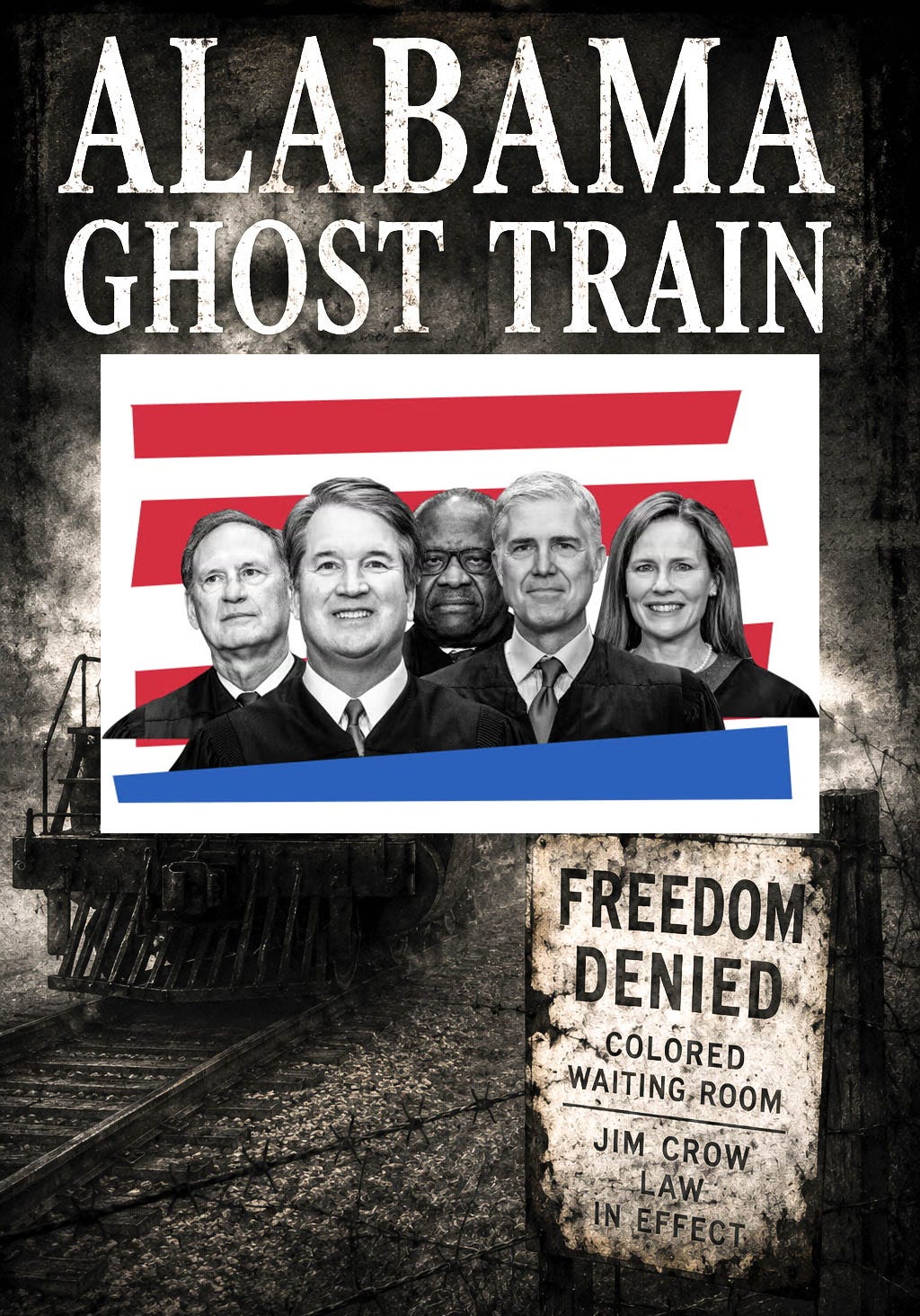
I cannot adequately express the anger I feel toward this latest chapter in the long, shameful story of American racial injustice. Every time Chief Justice John Roberts steps before a microphone to defend the Court’s actions, to wrap deeply consequential decisions in the language of constitutional restraint and judicial neutrality, I am reminded that power has always found eloquent ways to excuse itself. His reassurances ring hollow to those who understand history. They sound less like the guardianship of democracy and more like the careful maintenance of privilege. A liar’s liar among subservient demagogues. There are moments when I wish men such as Roberts could be stripped of their lofty titles, their black robes, their institutional grandeur, and transported backward through time. Let them stand beneath an unrelenting Alabama sun. Let him pick cotton if only for a single day, the weight of the indignities endured by generations of Black Americans whose lives were sacrificed to enrich others and whose voices were systematically silenced whenever they threatened the existing order.
The same thought occurs when observing the casual indifference with which members of this Court discuss matters that affect the lives of millions. One imagines Amy Coney Barrett speaking confidently about liberty and equality while forgetting the realities that shaped the lives of countless women throughout Southern history. Let her imagine childbirth not in the safety of a modern hospital but in the sweltering backwoods beyond the plantation house, dependent upon folk remedies, exhausted midwives, and the fragile hope that mother and child might survive the night. Such experiences were not historical abstractions. They were daily realities for poor women, Black women, and those denied the privileges that insulated others from suffering. It is easy to speak of tradition when one has never been forced to endure the burdens that tradition imposed.
Then there is Clarence Thomas, whose career remains one of the most bewildering tragedies in modern American public life. Here is a man who climbed a ladder built by the sacrifices of those who fought segregation, voter suppression, and racial exclusion, only to spend much of his public career dismantling the very protections they struggled to secure. The spectacle of a Supreme Court justice accepting the generosity of billionaires while preaching self-reliance to ordinary citizens would be comical if its consequences were not so profound. There is something deeply unsettling about watching a man who should understand the scars of American racism lend his authority to decisions that make it more difficult for marginalized communities to defend their political rights.
Years ago, I wrote Alabama Ghost Train as a reminder of a different story. It was not merely a song. It was an act of remembrance. It imagined the aspirations of a young woman of colour determined to leave behind a world of repression, submission, and fear. She boards a train heading north, carrying little more than hope and determination. The destination offers no guarantees. The North contains its own prejudices, its own barriers, its own disappointments. Yet it offers something precious that much of the South denied for generations: the possibility of breathing without the constant threat of racial terror hanging over one’s shoulder. It offers distance from the men who wore white hoods and from the officials who too often wore black robes while accomplishing the same ends through different means.
The Supreme Court’s decision regarding Alabama’s congressional map is not merely another technical legal dispute buried within the pages of judicial opinions. It is part of a much larger story about power, representation, and whose voices matter in American democracy. The Court did not explicitly declare partisan gerrymandering legal. That is the narrow legal description. The practical reality is something else entirely. By allowing Alabama to use a congressional map that lower courts found intentionally diluted Black voting strength, the Court has once again signalled its willingness to weaken the tools that minority communities have relied upon to challenge discrimination. The six-to-three ruling allows Alabama to proceed with a map expected to produce an additional Republican-leaning congressional seat, despite findings by lower courts that the legislature acted with discriminatory intent.
This decision cannot be separated from the Court’s earlier ruling in Louisiana v. Callais, which significantly narrowed citizens’ ability to challenge district maps under Section 2 of the Voting Rights Act. Taken together, these decisions represent a profound shift in the legal landscape. Critics, including the dissenting justices, argue that the Court is steadily dismantling safeguards designed to prevent racial vote dilution. Supporters insist they are preventing race-based districting and restoring authority to the states. Yet history teaches us to be skeptical whenever those in power claim that restrictions on voting rights are simply matters of administrative convenience or constitutional principle.
The tragedy is that none of this occurs in a vacuum. Alabama occupies a unique place in the American imagination because its history embodies both the cruelty of racial oppression and the courage of those who resisted it. After becoming a state in 1819, Alabama built much of its prosperity upon cotton plantations worked by enslaved African Americans. By 1860, nearly half of the state’s population consisted of people held in bondage. They were denied freedom, denied legal protections, denied the right to determine the course of their own lives. Following the Civil War, newly emancipated citizens briefly experienced the promise of Reconstruction, only to face a ferocious backlash from white supremacist organizations determined to restore racial hierarchy by any means necessary.
The rise of Jim Crow transformed discrimination into a comprehensive system of social control. Segregation governed schools, transportation, housing, healthcare, employment, and public life. Black citizens encountered barriers at every turn. Violence reinforced the system. Lynching, intimidation, and economic retaliation became tools used to maintain white supremacy. Entire communities lived under the constant threat that any challenge to the racial order could be met with brutality.
Yet Alabama also became one of the movement’s great battlegrounds. Montgomery, Birmingham, and Selma occupy sacred ground in the history of democratic struggle. Rosa Parks, the Montgomery Bus Boycott, the Birmingham campaign, the fire hoses, the police dogs, the Selma marches, and Bloody Sunday forced the nation to confront realities it preferred to ignore. The courage displayed by ordinary citizens helped secure the Voting Rights Act of 1965, one of the most significant democratic achievements in American history.
That history is precisely why contemporary voting rights disputes carry such weight. They are not simply disagreements about lines drawn on maps. They are concerned about whether the hard-won victories of previous generations will be preserved or gradually eroded. The battles fought in Alabama were never solely about Alabama. They were about the meaning of citizenship itself. They were about whether democracy would remain the property of the powerful or become accessible to everyone.
The elections of November 2026 may well prove among the most consequential in modern American history. The decisions being made now will shape representation, voting rights, and democratic participation for years to come. The question confronting Americans is not merely which party gains an additional congressional seat. The deeper question is whether the nation still possesses the moral courage to learn from its own history. A democracy that forgets how hard previous generations fought to secure equal representation risks surrendering those gains piece by piece, decision by decision, opinion by opinion, until the promises carved into its founding documents become little more than ceremonial words.
History has a long memory. Alabama knows that better than most places. So do those who continue to fight for a democracy that belongs to all its citizens rather than a privileged few.
Reminds me of the book by David Brock titled Stench The Making of the Thomas Court and The Unmaking of America